Every day, it becomes clearer that Contemporary Art, as a project, is reaching a point of exhaustion. The biennial circuit, the mega-gallery, the celebrity curator, the international art fair, the MFA program, and the river of capital that flows through them, all seem to be on the verge of drying up. For a time, Contemporary Art was one of the defining cultural expressions of late capitalism. There was a capital creep into the conditions of how the artworks were realized, a slow march toward an obsession with marketability, provenance and fame. Their symbolism, whether or not the artist intended it, gave form to these flows, the art itself becoming a vessel for the buy-hold-sell cycle. It’s possible we’re simply in a valley. It’s also possible the next few peaks are shorter than the last, and the ones after that, until we no longer recognize the industry.
We at haul gallery are not committed to the survival of The Project of Contemporary Art. Our focus is what kinds of artistic practices survive independently of The Project, and what will outlast it altogether. We have long focused on artists working outside the market and trend cycles of the contemporary art industry. In doing so, we noticed that there exists a certain kind of artist whose practices persist beyond the tides of market moves or institutional trends.
These artists are often compulsive makers, and their lives tend to fit around their practice, not the opposite. Some of these artists can at first appear peculiar or sometimes not like artists. Throughout our years, we’ve seen these artists emerge on social media by accident, spotted their work from an apartment window, or received mysterious emails we could not forget. This group is not tied to a particular medium. All of them are unusually prolific. They pursue a practice they cannot abandon. Their works are forcefully idiosyncratic, not determined by virality and clout. Defining them is difficult, but there’s a you-know-it-when-you-see-it signal that one can learn to recognize. The term we’ve landed on is: The Inevitable Artist.
The Inevitable Artist exhibition is open
Sept 12 - Oct 11, 2026
MIKE HACK
JRN
BORUT HOLLAND
JOSÉ ÁNGEL
JOHN RIVAS
JASON BLUE LAKE MEDICINE EAGLE MARTINEZ
JADA HAIRSTON
PORPENTINE CHARITY HEARTSCAPE
Defining the Inevitable:
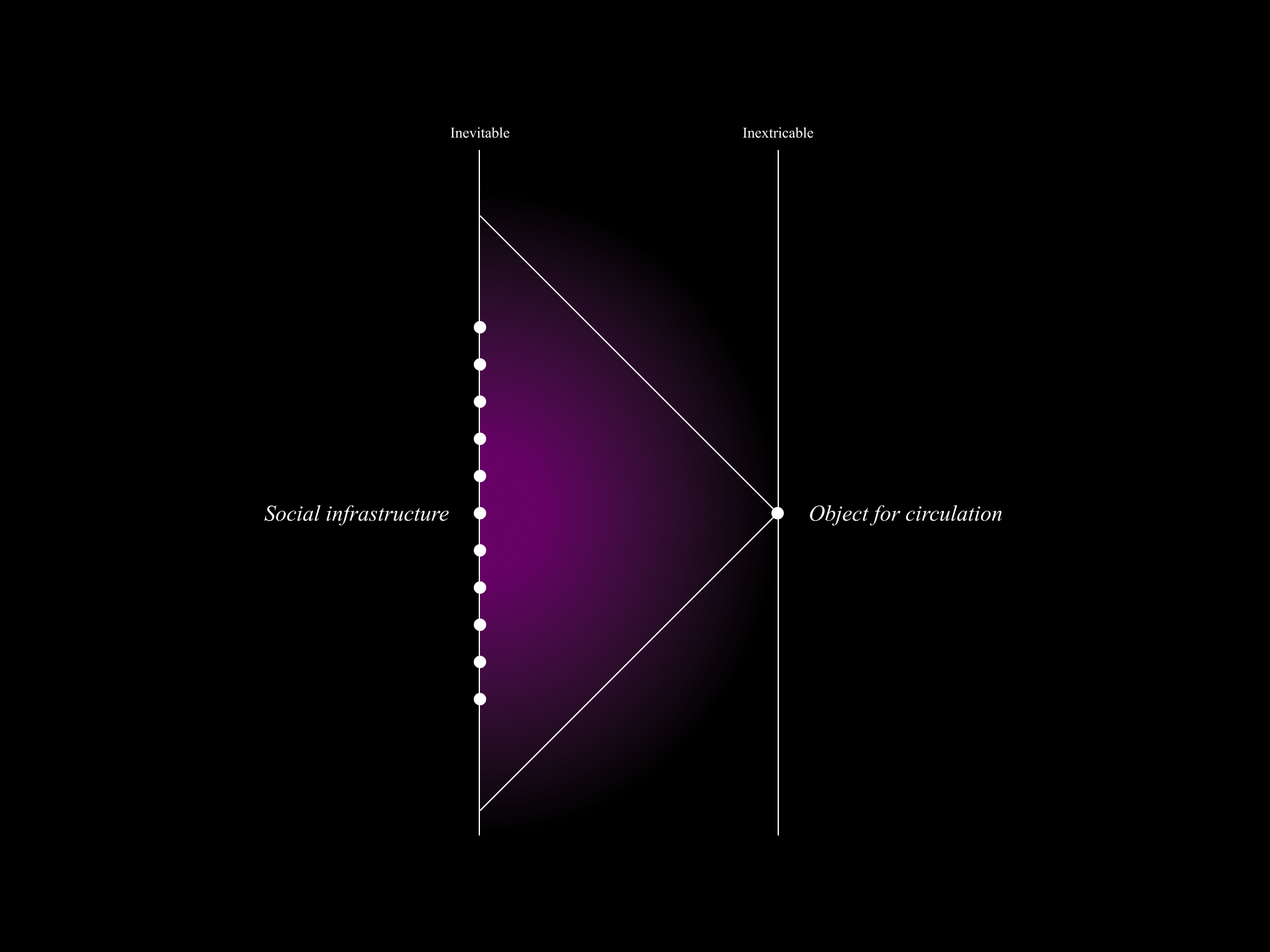
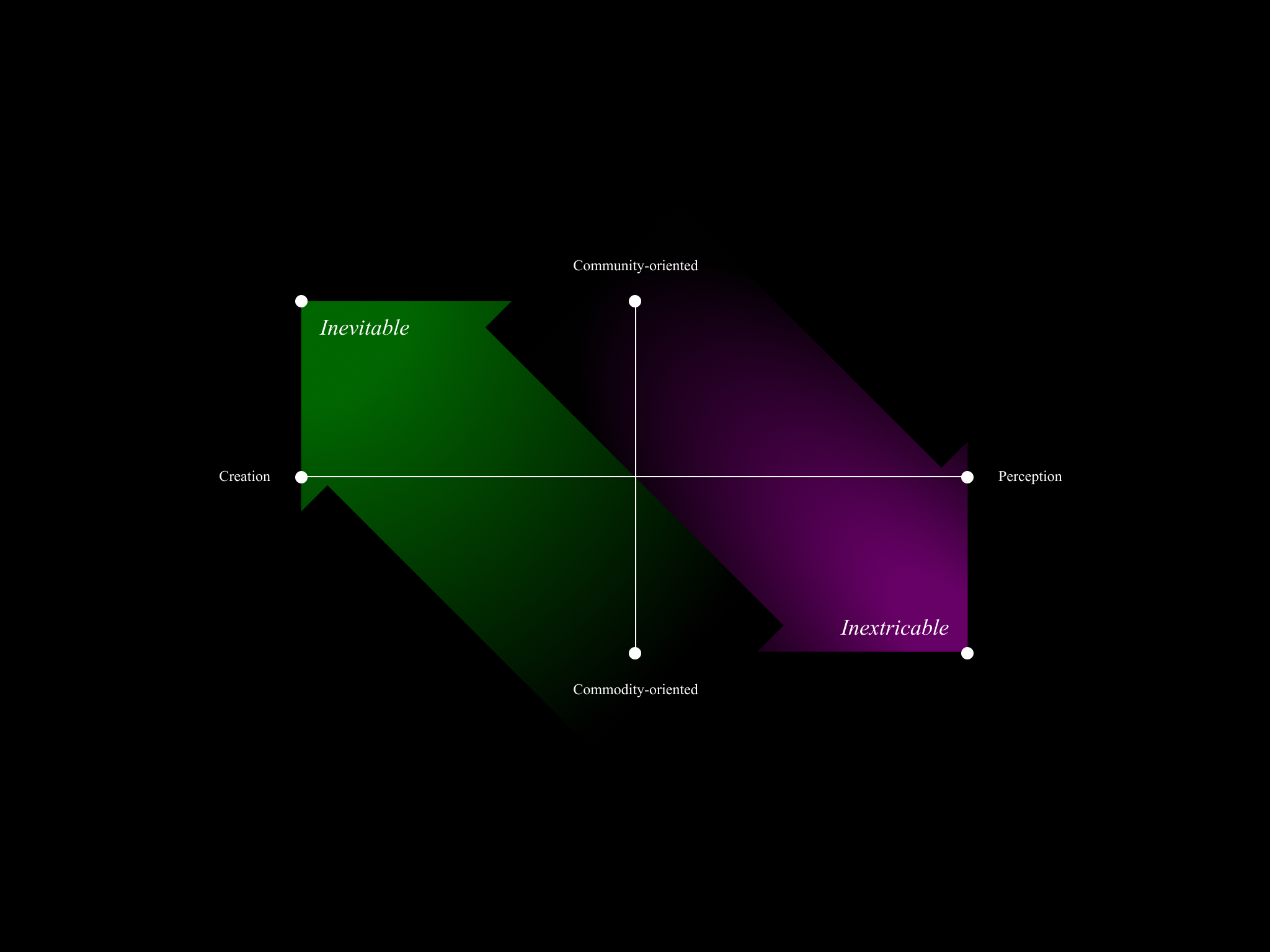
Inevitable Artists are primarily defined by their lack of dependence on the Project of Contemporary Art. Museums, galleries, grants, collectors, and critical attention may affect the visibility or scale of the work, but not its existence. They often work for years with no recognition, and they will continue to work if recognition wanes. Economic and infrastructural changes may shift around them, but their practice persists. Whatever they make can expand or contract depending on their circumstances. Their work develops an internal logic capable of persisting across changes in medium, scale, and circumstance. A deliberate extreme to consider: can some form of the artist’s practice persist in wilderness? Would it still be recognizable?
Community involvement and collective support is a common thread among Inevitable Artists. Art making for many of them acts as a communication methodology for everyday life. Mike Hack, a video artist with autism, uses his video production process as a means of establishing social relationships. juliana roccoforte novello’s hybrid social-work, filmmaking, and photography practice makes artistic collaborators out of lifelong, working-class New Yorkers who might not otherwise make art. Ibisazi Designers Nyabyo, whose work pushes against Rwandan cultural norms, has made their studio into a gathering and education center. In each case, making becomes part of the infrastructure of everyday social life.
There is some crossover with what has historically been called outsider art, naïve art, art brut, or visionary art. Many artists historically described as outsiders would also be inevitable artists, but the category of the Inevitable extends far beyond outsider art. Sadly, these older terms have become synonymous with a market category, one that relies on exotification of the artist’s psychology. And now, despite repeated institutional acceptance of self-taught artists from outside academia, the term “outsider” persists only to describe an aesthetic, ideal buyer, or price point. This forces the artworks to become critically inseparable from the art market. To be outside implies one can be invited in. These terms belong to a different historical moment, one where institutions had a coherent, canonizing authority. That authority has since become fragmented.
We acknowledge the possibility of “inevitable” meeting the same promotional fate as “outsider;” however, a crucial contingency of an Inevitable Artist is a demonstrated body of work made outside any market conditions whatsoever. If the term becomes overly marketized, it will contradict itself.
Older outsider categories described unfamiliar makers working in familiar media. The present landscape also confronts us with unfamiliar forms of making. Today’s media landscape allows inevitable practices to emerge through novel forms that may not initially be recognizable as art. Software, short form video, ARGs, video games, and streaming are recent examples. No matter the medium, these artists hold strong to their idiosyncrasies despite the rip-tides of social media’s flattening effects. In learning to recognize the Inevitable Artist, we can better understand forms of art making whose existence is not wholly determined by markets or algorithms, and avoid corralling the ineffable art making impulse into capital confinement.
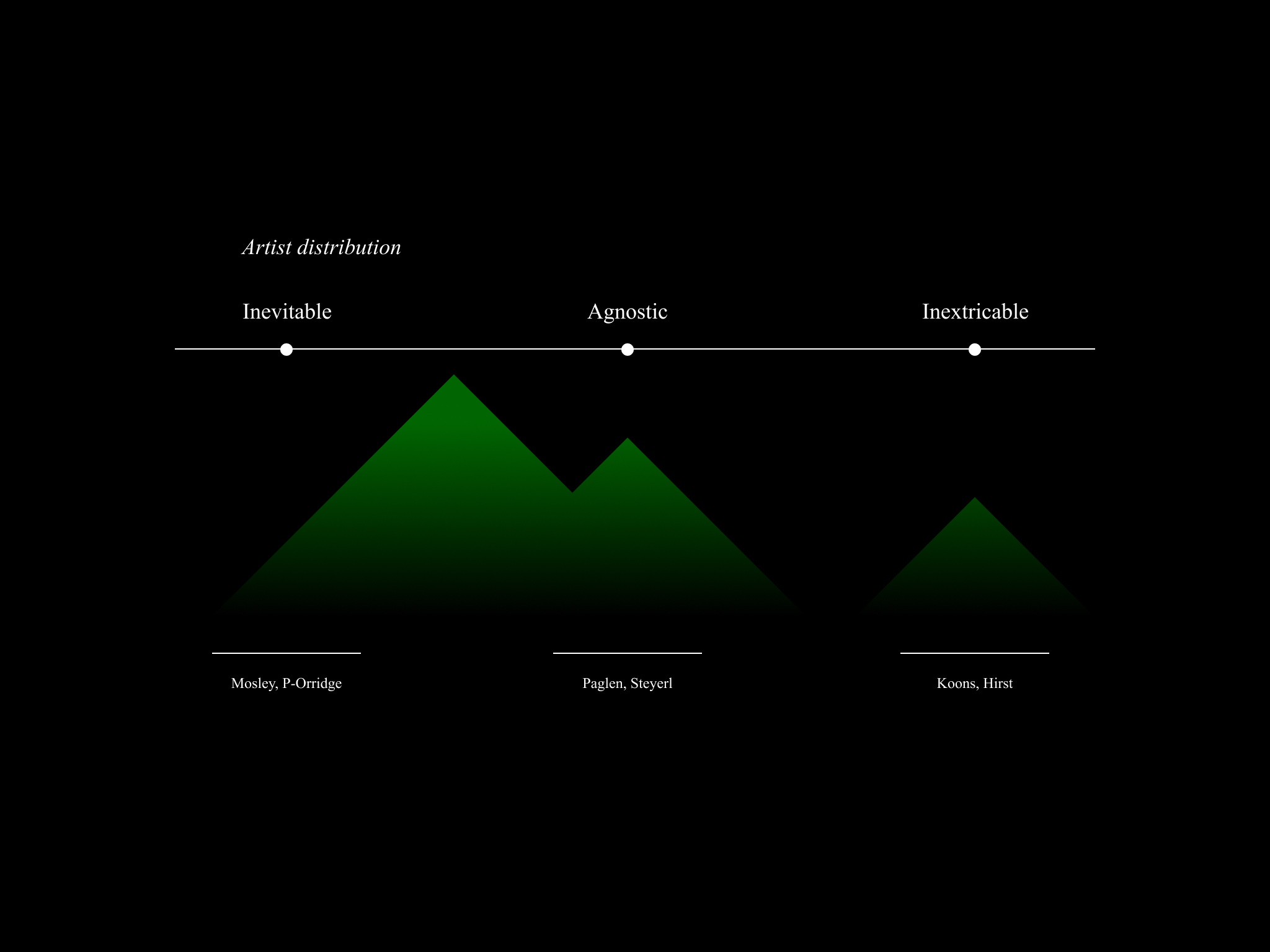
Lastly, Inevitable is not a measure of the quality of work. All artists have the potential to be memorable or forgettable. Some of the strongest influences on haul gallery (and its founders’ own practices) have not been inevitable artists. Artists exhibit varying degrees and kinds of dependence on the institutions of Contemporary Art. Another calibration: to what extent has Contemporary Art itself become part of the artist’s medium? We use medium in a broad sense, beyond the physical stuff. For some artists, the infrastructure itself—galleries, institutions, criticism, spectacle, and capital—are part of the work’s intrinsic form. We imagine the varying degrees of dependence on a spectrum:
The Inevitable and the Inextricable:
The spectrum begins, of course, with Inevitable Artists. Some well-known examples include: Thaddeus Mosley, Genesis Breyer P-Orridge, Alan Saret, Porpentine Charity Heartscape, and John Rivas. We would also include Jean-Michel Basquiat.
At the opposite end are Inextricable Artists. Here, the practice cannot be meaningfully separated from the infrastructure of Contemporary Art itself. Jeff Koons is perhaps the clearest example. Jeff Koons, as a project, entity, and corporation, would not exist without the project of Contemporary Art. His studio depends upon a global network of fabrication, collecting, museums, criticism, logistics, patronage, and spectacle. Those structures are not merely supportive of the work. They have become part of its medium. Others include well-known heavy-hitters: Damien Hirst, KAWS, Richard Prince, Urs Fischer, and Julie Mehretu.
In the middle are Agnostic Artists. Agnostic practices may require institutional support, but they do not specifically require the institutions of Contemporary Art. Their methods and central questions can migrate elsewhere. They are often researchers, systems-thinkers, theorists and sometimes-authors. The hyphenated artist. Trevor Paglen’s investigations into surveillance, military technology, artificial intelligence, and state power could continue through journalism, publishing, academia, or scientific collaboration as readily as they do through exhibitions. Contemporary Art is one context for the work, but it is not a necessary condition for its existence. Examples include: Hito Steyerl, Simon Denny, Mark Leckey, Christopher Williams, Walid Raad, and Cameron Rowland.
Most artists tend to fall somewhere in between Inevitable and Agnostic. Even artists without the institutional support they might desire will continue to make art; however, arts education, and a deliberate dialogue with the histories and traditions of contemporary art are conditions that exist on this part of the spectrum.
A simple summary: Inevitable means low institutional dependency. Agnostic means institutionally dependent but not specifically dependent on Contemporary Art. Inextricable means specifically dependent on Contemporary Art because Contemporary Art has entered the medium itself. We realize ‘dependent’ may be read in a negative light, but this is not a hierarchy or a character judgement of the artist. Every point on the spectrum has produced remarkable artists. Our interest is descriptive rather than evaluative.
The terms describe regions of a spectrum, not sealed categories. Few artists occupy either endpoint completely, and an artist’s position may shift over time. The question is not merely whether some reduced form of the work could continue without Contemporary Art, but how much of the practice’s defining form would survive. Institutional support can enlarge any practice. For an Inevitable Artist, that scale remains contingent and reversible. As a practice approaches the Inextricable end, the system’s scale, circulation, and infrastructure become increasingly constitutive of the work itself.
Ultimately, we are asking a material question: what conditions does a given practice require in order to exist? We suspect this question is becoming increasingly important. If the project of Contemporary Art is entering a period of transformation, contraction, or even conclusion, then the artists most likely to shape what comes next may not be those most deeply embedded within its institutions. They may be those whose practices have always possessed an internal momentum of their own.
The Inevitable Artist reminds us that art has never been reducible to the systems that distribute it. Galleries, museums, fairs, and markets are historical formations. They emerge, they change, and eventually they disappear.
The impulse to make precedes them all.
graphic design by Michael Ryan Wood